
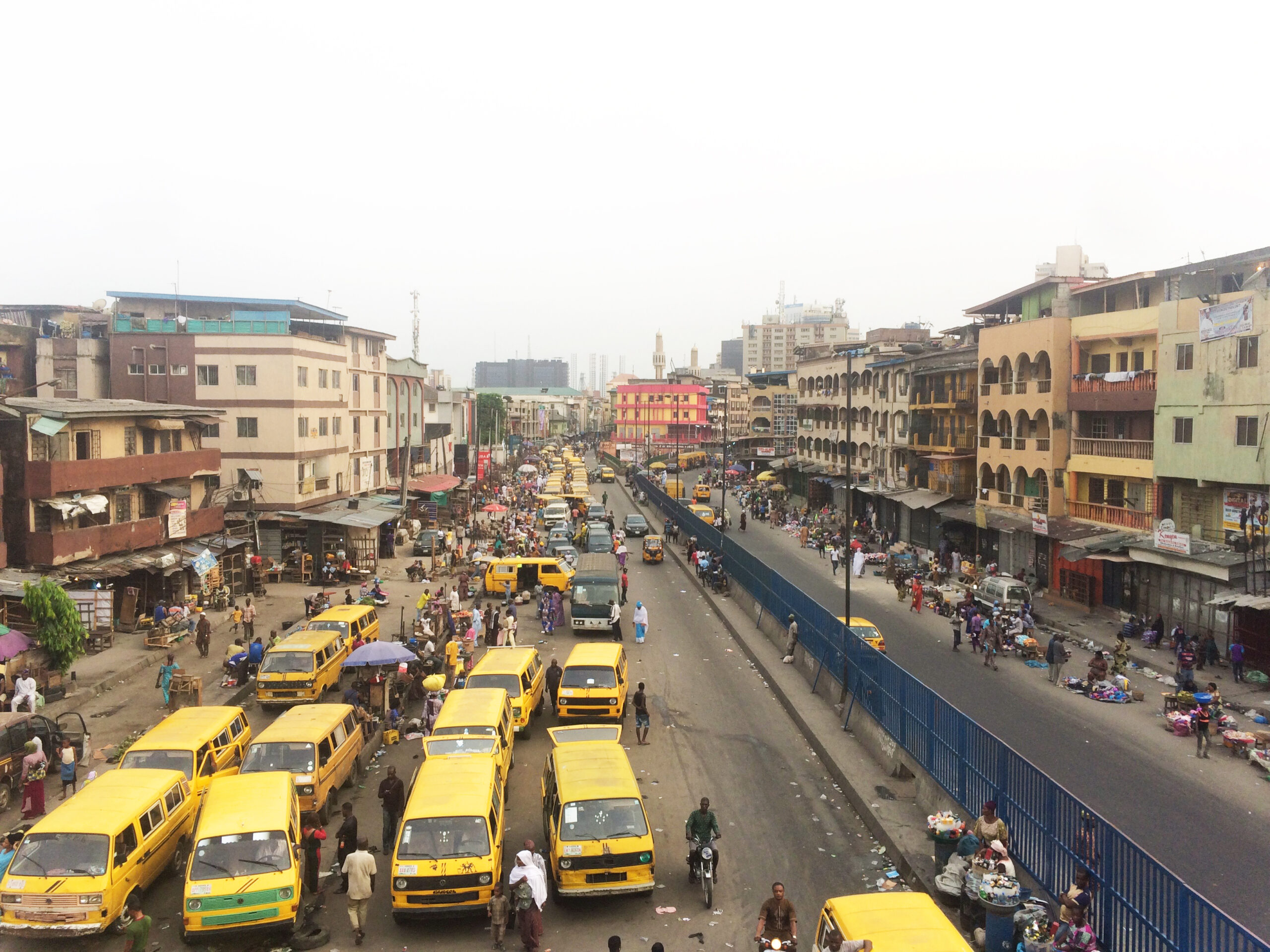
by Mathias Juul Frost
In 2017, we travelled to Lagos — a team of five architects and three artists — led by Baerbel Müller from [Foreign Affairs] at Die Angewandte. Paired with three Nigerian artists, we shared the aim of investigating the old railway compound in Ebute Metta, Lagos, Nigeria — a process that culminated in a collaborative group exhibition, later recognised as the first pre-biennale of Lagos.
Along the way, we engaged in conversation with curators, activists, historians, and urban thinkers.
The following three texts — Sound as a Space-Creating Tool, Railway Mosque and This House Is Not for Sale — emerged from that encounter. Together with photographic documentation, they unfold different aspects of the site: between formal absence and informal agency, between sound, space and city — between sacred, personal, and public ground.
Sound as space creating tool
Polyrhythm in West African music is an organising principle — a layering of independent rhythms without a fixed beginning, middle or end.
It forms a continuous, evolving space.
Having inspired music globally — from Fela Kuti and Afrobeat to Jazz, Funk and hiphop — its significance reaches far beyond sound. It builds on a social and existential core. Polyrhythm is the backbone of a worldview in which the co-existence of difference is a generative force — a system where independent rhythms challenge, respond to and transform one another.
Incomplete on their own, each rhythm leaves intentional gaps — open to be answered by the other. Rather than seeking resolution through sameness, the rhythms weave into a complimentary whole.
The music becomes a spiritual and social act, as distinct rhythms each with its own pattern, speeds and mode of existence — interlock temporarily to form an asynchronous field of relations.
Sanford Kwinter — philosopher and professor at Die Angewandte, Harvard and Pratt writes in “Beat Science”(2009) on the “interlock effect”: disparate series of elements find moments of coupling while demonstrating a willingness to part.
He describes rhythms that temporarily engage in a continuous composition — one that never freezes. A dynamic shaped by a readiness to couple, an acceptance to part, and a shared awareness of the whole.
Here, harmony is not a fixed ideal, but an evolving negotiation — uncontained and free.
Polyrhythm — and the interconnectedness of the interlock effect — offers a way to understand howthe seemingly independent layers of the city — people, movements, sounds, desires — continuously meet, negotiate, diverge, and recompose.
In the absence of a formal social system,
survival becomes an individual responsibility.
In this void, faced with immediacy, a different structure emerges: Polyrhythms and the interlock effect become reflections of a fluid foundation — a continuously evolving social structure. Not enforced from above, but composed through relational necessity. The individual exists through the presence of the other, relying on the fleeting yet vital connection.
This reflects a deeper African philosophy — Ubuntu: I am because we are.
It speaks to a general trust in life — in the unknown. Safety here does not lie in sealed and resolved systems, fragile in the face of change, but in a resilient nature where survival, risk and change are integrated parts of life.
Through this, a vibrant force emerges:
In order to survive
you need to sell
In order to sell
you need to create a personal space ( to be noticed )
In order to create a personal space
Sound becomes the tool ( to represent whatever you are selling )
Sound becomes a space-creating tool
The carpenter, the hairdresser, the car mechanic — each has a sound.
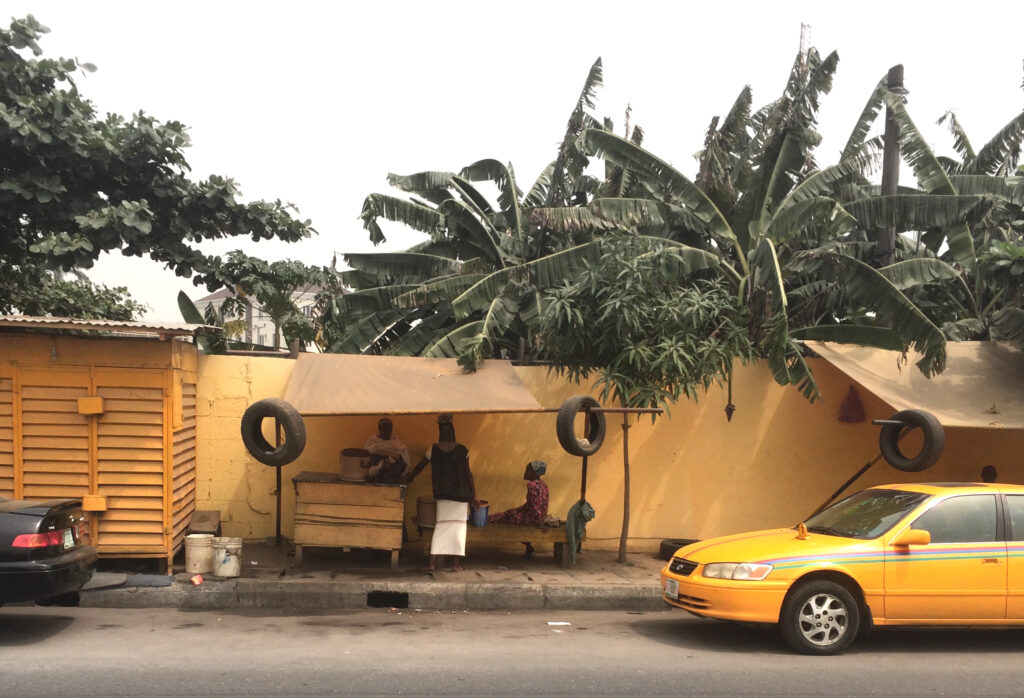
It is in the public arena that the means for survival are pursued — transforming what we perceive to be public space into a field of shifting micro territories, each essentially becoming private. Through momentary appropriations; an urban wall becomes the backdrop of a barber shop, a corner becomes the neighbourhood bike repair. The city morphs.
These temporary appropriations form individual rhythms — independent layers within the larger urban composition. The interlock effect becomes a choreography of proximity and parting — a city where disparate elements momentarily align, not through imposed structure, but through the shared necessity of survival.
This dynamic turns Lagos into a zone of continual negotiation.
The european city, on the other hand absorbs much of the interpersonal and spatial friction through regulation — at times at the risk of stiffening the joints and sedating the mind, as the system anticipates your steps and directs your movement.
In Lagos, it is the people who absorb the city. Moving with rhythm and improvisation, a kind of softness emerges — like baby bones, able to take in the sudden edges of the environment. Awareness becomes instinct, a necessity for navigating changing conditions.
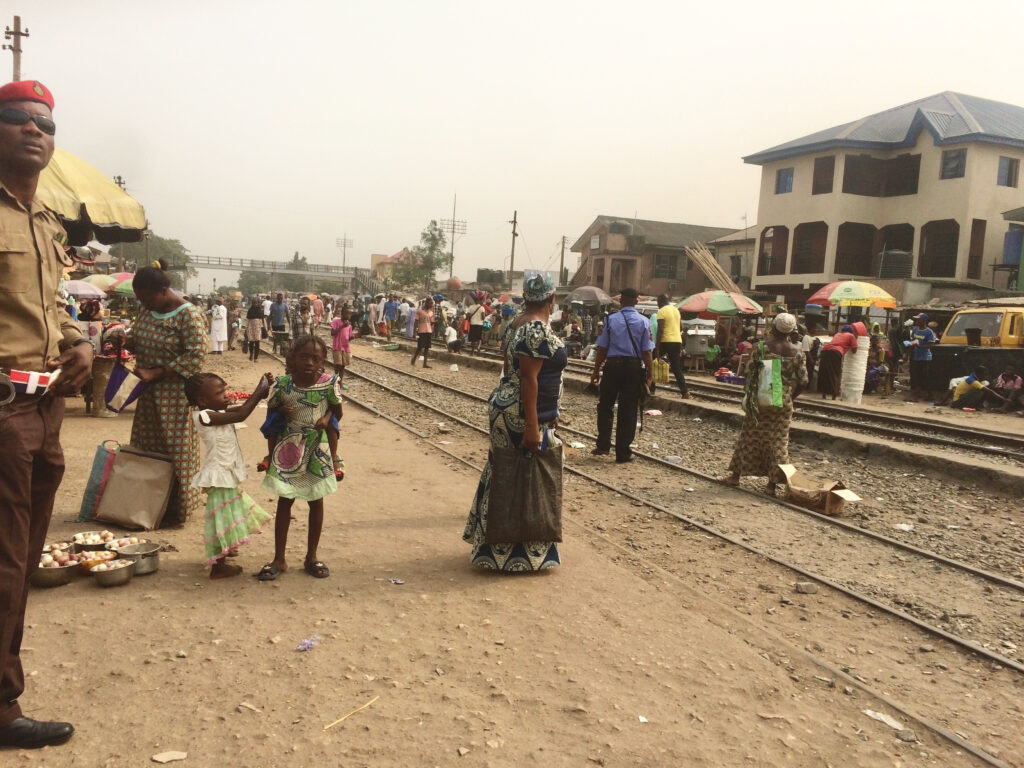
The body becomes the main actor.
Here, the relationship between city and inhabitant has been reversed; it is no longer the city that sets the boundaries and directs the sound, but the people who are forced to do so — continually re-negotiating their own boundaries.
The city has become light — almost invisible — as it ceases to direct.
Its boundaries loosen — as its frayed edges leave intentional gaps, creating a sense of openness that amplifies its vitality. The organisation of the city morphs — iteratively redefined, not by design, but by the desires of its people.
The city is under siege — by its own inhabitants.
__________________________________________________________________________
Note: This text is not a glorification. Lagos is a tough city where many are left behind. Yet it remains a ground for curious investigation — a place of immense vibrance, one we can learn from.
__________________________________________________________________________
Railway Mosque
A small patch of land.
Deep within a city of 20 million people,
the world’s largest agglomeration of Christians and Muslims living side by side,
further layered with 500 distinct languages and 350 ethnic groups, including Yoruba, Igbo and Housa…
Behind a three-metre-high wall,
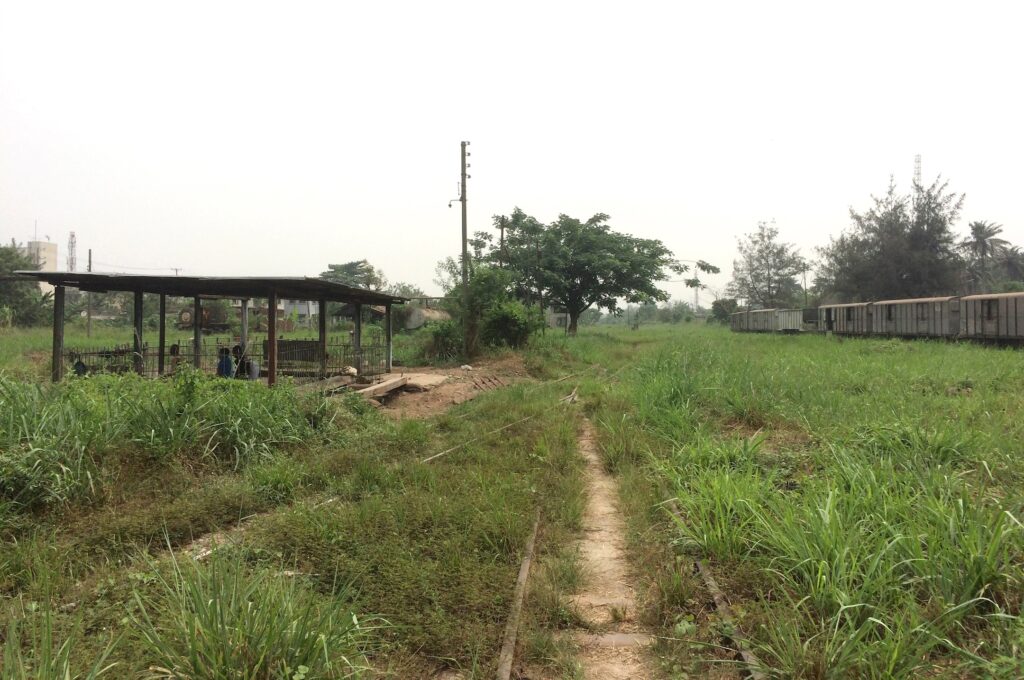
the railway compound still stands today.
Established by the British in the last century.
Today, a place of relief for the surrounding neighbourhood,
perhaps the only semi-public space in Lagos.
Lush vegetation flourishes here.
Protected.
A sacred pocket.
A spatial gesture.
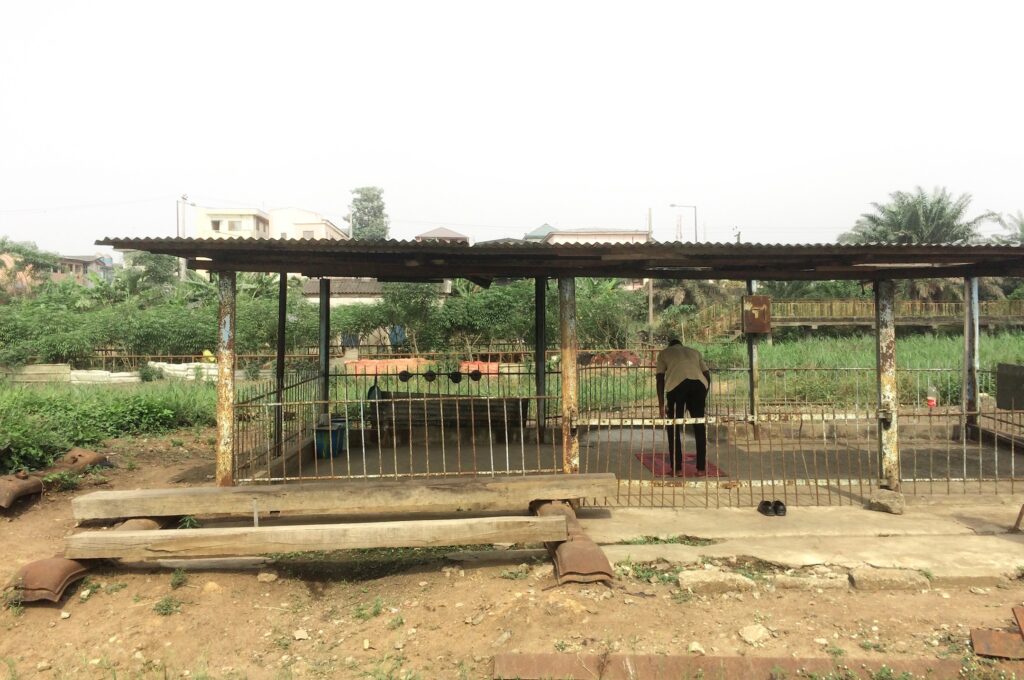
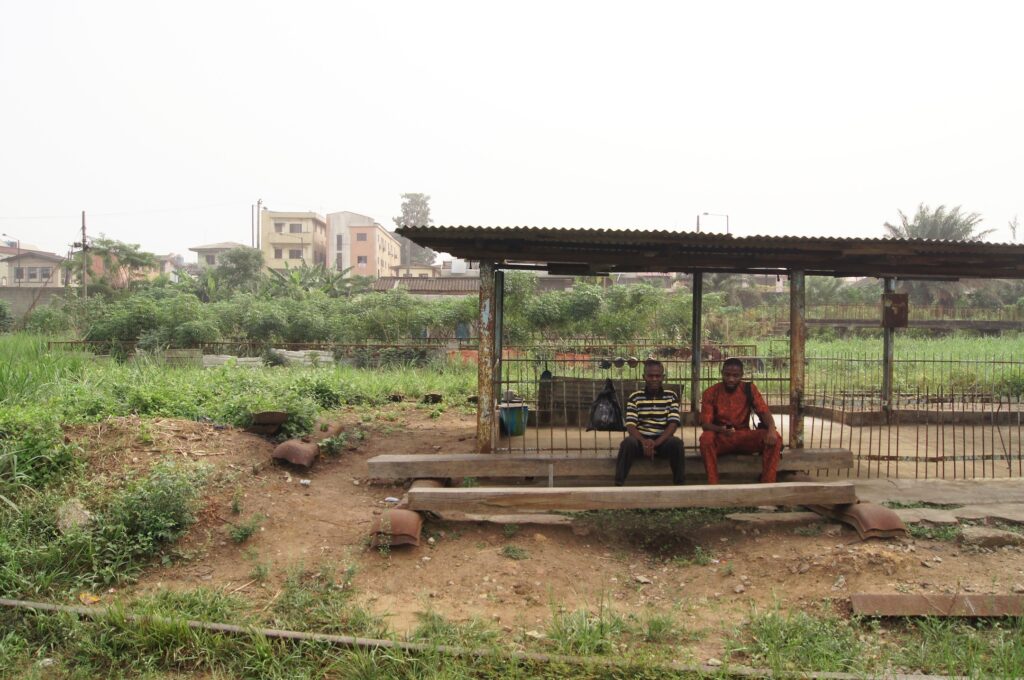
Stepping through the small fence,
onto the plateau, signifies a transition.
Leaving the profane behind,
another set of rules applies.
Here, railway workers can pray in peace.
This house is not for sale
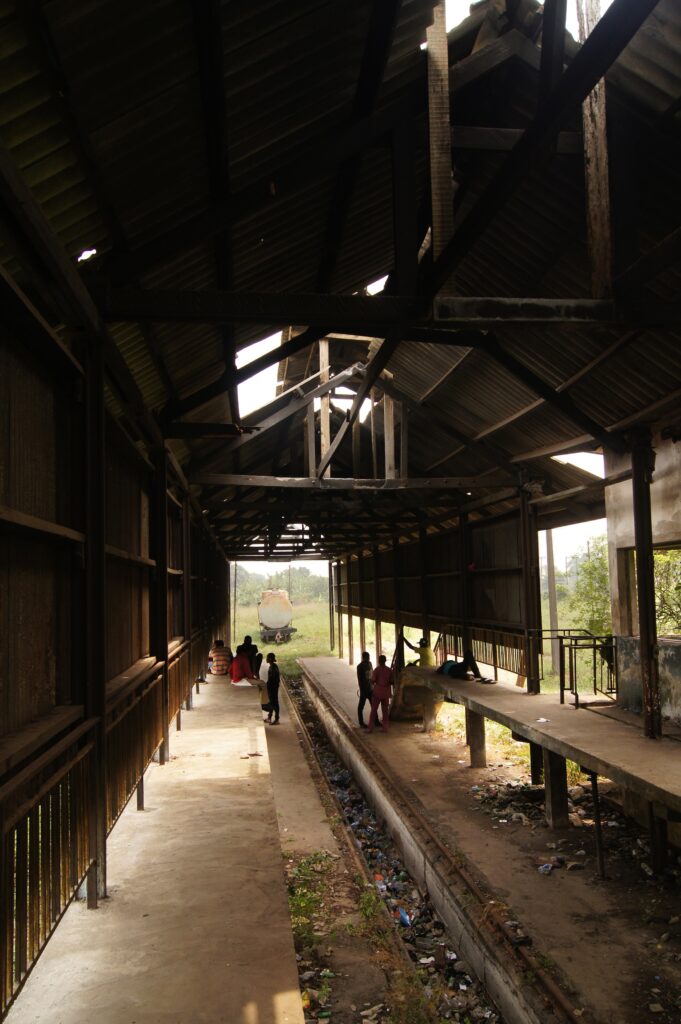
This House is Not for Sale explores transformation and the lingering value of the unresolved. Once a clearly defined functional structure — a space for train maintenance — the building gradually lost its purpose over time and began to dissolve into something else. It became a place of relief.
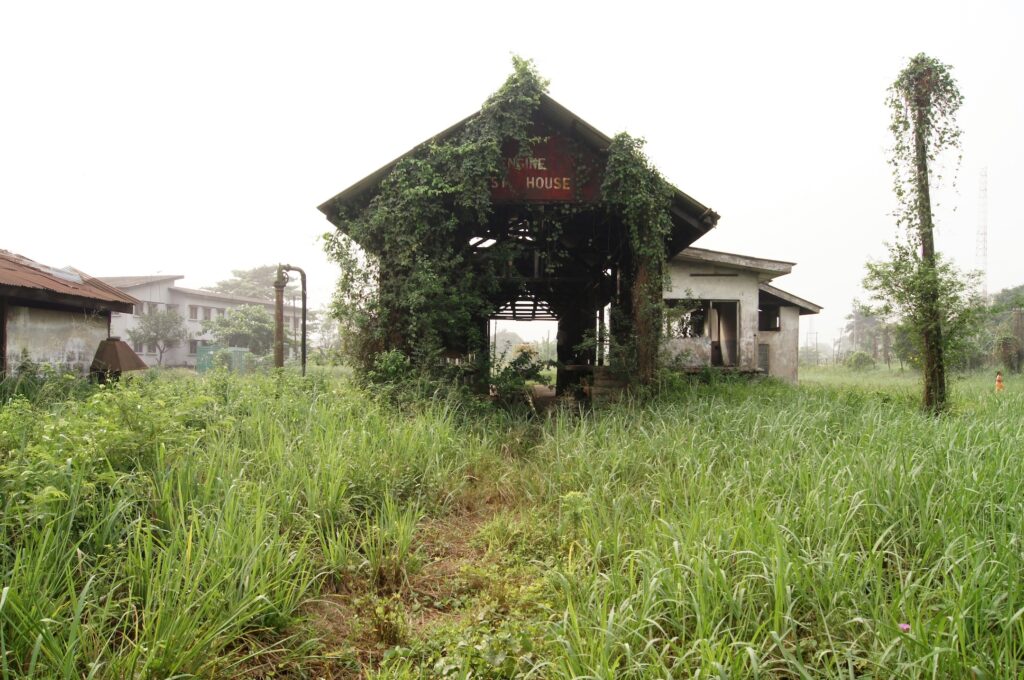
Functionally liberated and shielded by a kind of “privacy”, the building now serves as a rare semi-public space in the neighbourhood of Ebuta Metta, Lagos, Nigeria.
As the spatial and functional rhythms once moved in sync,
their alignment gave the space clarity and direction.
Perception was a given.
As the function dissolved,
a rhythm began to loosen, to drift off.
A rhythmic divergence
is a gift.
The spatial direction remained — now omnipresent.
Liberated in perception,
it offers no answers, making no demands.
Its nothingness became its charge —
an architectural gesture.
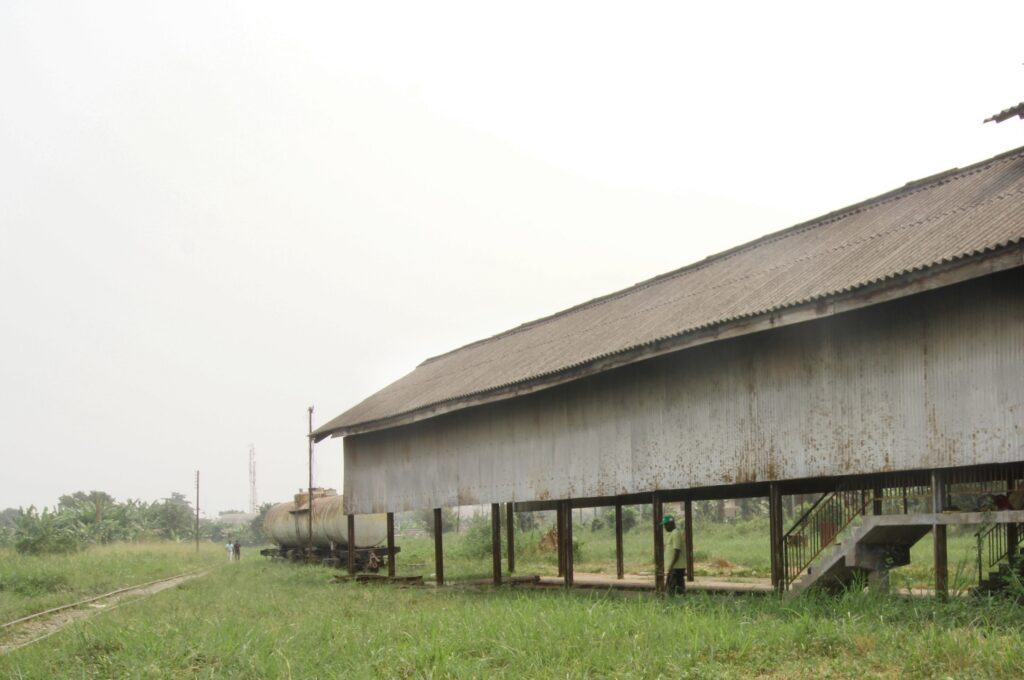
Hanging out with the guys at the shed, it became clear that the project revolved around recognising what was already there. Photography and text became a subtle way of nourishing the perception of the space and its inhabitants.
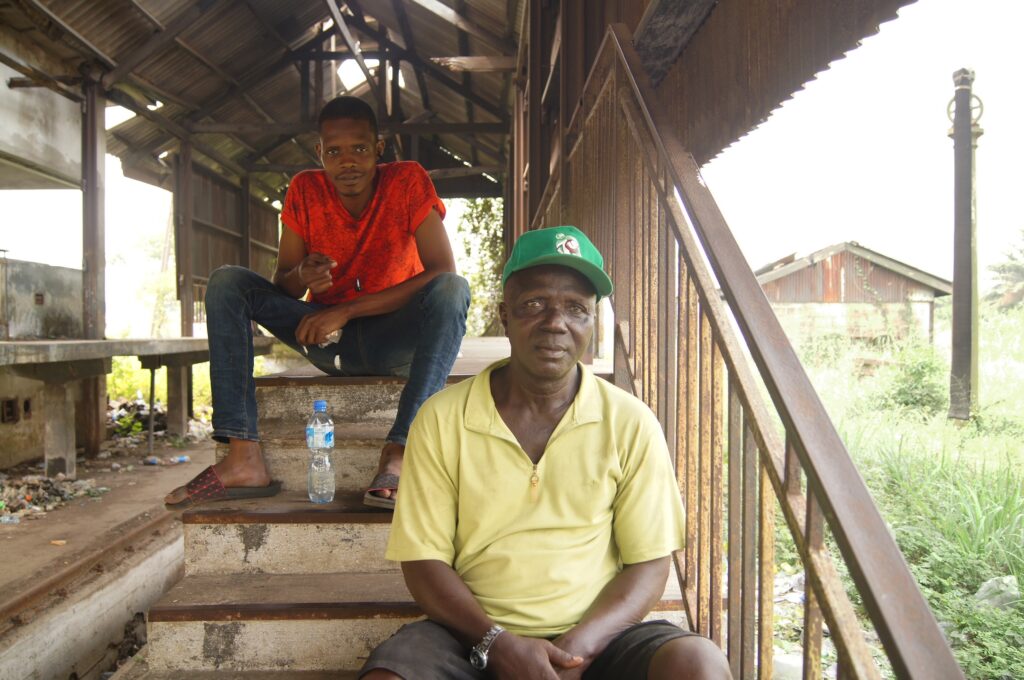
The building became its own exhibition: Five photos and two texts were printed on aluminum and scattered around the space, freestanding. The exhibition dissolved during the night — dispersed into the homes of the guys themselves — becoming a continuous subtle reminder.
An architectural gesture — a container of of public being — marking a transformation from what to how, from noun to verb. The space shifts from a fixed identity to one of relation, an architecture distilled to its mere physical presence — a structure — serving as a juxtaposition of uses, perceptions and presences. It stands as a resilient spatial anchor, providing a sense of relation both for its users and its neighbourhood.
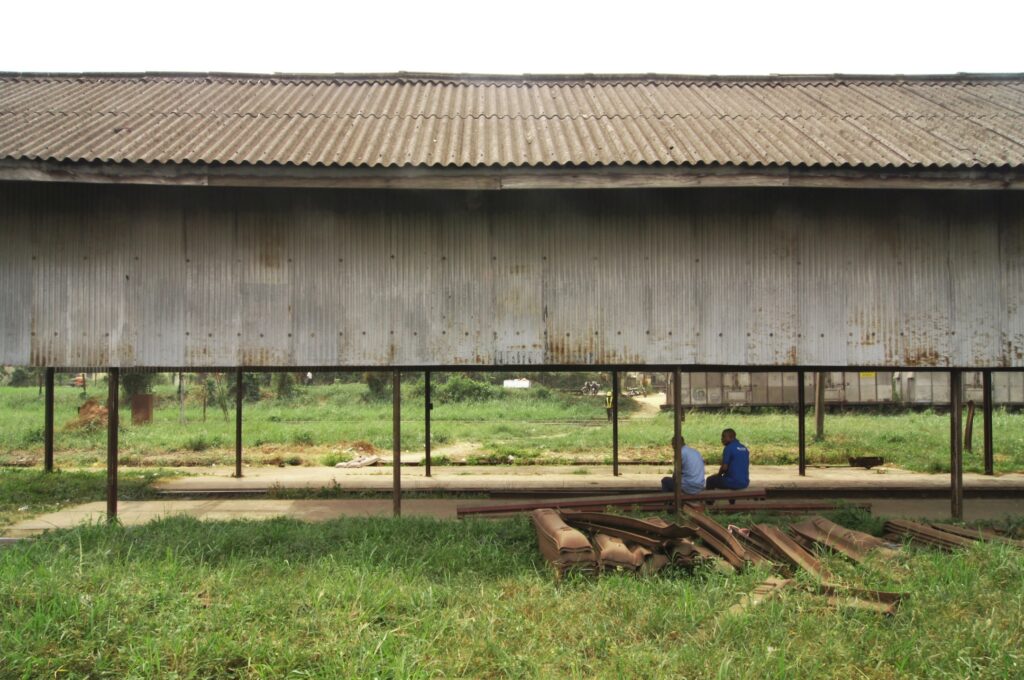
We live in a time where we seem dependent on answers. The beauty of this space lies in its absence of neither providing nor demanding answers.
Note: The phrase “This house is not for sale” is painted on countless buildings across Lagos as a protective claim. It is a way for people to resist both state and private appropriation.